


Gratuity - Meaning, Eligibility Criteria & How to Calculate it
What is Gratuity?
Gratuity is a lump sum amount paid to an employee by an employer as a reward for long-term service, after one year, based on tenure and last drawn salary, with exceptions for disability.
Gratuity can be viewed as a financial token of appreciation provided by an employer to reward an employee for long-term service. Governed by the Payment of Gratuity Act, 1972, it is generally payable after five years of continuous service, although it may be paid earlier in cases of disability. The gratuity amount is determined based on the employee's tenure and salary.
Gratuity Calculation Formula with Examples
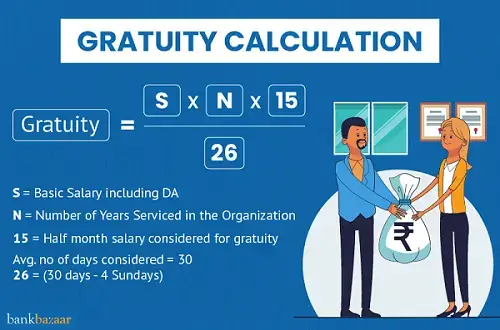
Gratuity Formula - Listed below are the components that go into the calculation of the gratuity amount. The amount is also dependent upon the number of years served in the company and the last salary drawn.
For Employers Covered Under the Gratuity Act:
Gratuity = (N*B*15)/26
where,
N = Number of Years Serviced in the Organization
B = Basic Salary including DA
What is 15/26? - 15 defines half-month compensation of 15 days and 26 represents the number of working days in a month (excluding Sundays)
- Example:
- 15 years of service, last drawn salary = Rs.55,000
- Gratuity = (15 × 55,000 × 15) / 26 = Rs.4,75,962
Important Notes:
- Gratuity amount is capped at Rs.20 lakh for private sector employees; excess is treated as ex-gratia. While the amount is capped at Rs.25 lakh for central government employees.
- If service in the final year exceeds 6 months, round up to the next full year (e.g., 18 years 7 months = 19 years).
For Employers Not Covered Under the Gratuity Act:
- Formula: Gratuity = (15 × last drawn salary × years of service) / 30
- Example 1:
- 8 years of service, last drawn salary = Rs.65,000
- Gratuity = (15 × 65,000 × 8) / 30 = Rs.78 lakh
- Example 2:
- Amit has worked with a company for 20 years and had Rs.25,000 as his last drawn basic plus DA amount, then,
- Gratuity Amount for Amit = 20*25,000*15/26 = Rs.2,88,461.54
However, an employer can choose to pay more gratuity to an employee. Also, for the number of months in the last year of employment, anything above six months is rounded off to the next number while anything below six months in the last year of employment is rounded off to the previous lower number.
1. Employers Covered Under the Payment of Gratuity Act, 1972
Who is covered:
- Any establishment with 10 or more employees, including factories, offices, shops, and institutions, is covered.
- Employees are eligible for gratuity after completing five years of continuous service.
- If an employee dies or becomes disabled, gratuity can be paid before completing five years.
How gratuity is calculated:
- The calculation is based on the last drawn salary and the total number of years of continuous service.
- Last drawn salary includes basic pay plus dearness allowance. It does not include bonuses, house rent allowance, commissions, or overtime pay.
- Rounding rules: If the last year of service exceeds six months, it is rounded up to the next full year. For example, if an employee has 12 years and 8 months of service, it will be counted as 13 years.
Example:
- Last drawn salary: Rs.45,000
- Years of service: 12 years and 8 months
- Gratuity payout: Rs.3,32,307 This example shows that even partial years beyond six months are counted as full years when calculating gratuity for covered employers.
Key points:
- Gratuity is not the same as a bonus. It is a reward for long-term loyalty and is a statutory entitlement.
- Employers must pay gratuity within 30 days from the date it becomes payable.
- If payment is delayed, the employer is liable to pay interest according to the rules of the Act.
2. Employers Not Covered Under the Act (Voluntary Gratuity)
Who can receive voluntary gratuity:
- Employers not legally required to pay gratuity may still choose to do so.
- Rules and calculations for voluntary gratuity may differ according to company policy.
How gratuity is calculated for non-covered employers:
- It is generally based on the last drawn salary and completed years of service only.
- Fractions of a year are not counted; only fully completed years are considered.
- Last drawn salary usually includes basic pay and dearness allowance, but employers may choose to include other allowances.
Examples of voluntary gratuity:
- Last drawn salary: Rs.60,000, years of service: 7 - Gratuity payout: Rs.2,10,000
- Last drawn salary: Rs.30,000, years of service: 15 - Gratuity payout: Rs.2,25,000
These examples show that only completed years are considered, and the calculation method may differ from statutory rules.
Key points:
- Non-covered employers cannot use the statutory rules for covered employers unless explicitly stated in company policy.
- Voluntary gratuity is flexible, but tax rules still apply to ensure compliance.
3. Tax Exemption and Maximum Limits
Government employees:
- Entire gratuity received by Central and State Government employees is fully exempt from income tax.
Private sector employees covered by the Act:
- Maximum tax-exempt gratuity is Rs.20 lakh.
- Any gratuity paid above Rs.20 lakh is treated as an ex-gratia payment and is taxable.
Private sector employees not covered by the Act:
- Tax-exempt gratuity is the least of three amounts:
- Rs.20 lakh
- Actual gratuity received
- Half a month’s average salary for each completed year of service
Key points:
- Tax exemption rules may change periodically.
- Payments above statutory or exempt limits are considered ex-gratia and are generally taxable.
4. Additional Clarifications and Points
Early payment:
- Gratuity can be paid before completing five years in cases of death of the employee or permanent disability.
Continuous service:
- Includes periods where the employee may have short breaks of less than six months, depending on employer rules.
Ex-gratia payments:
- Any gratuity paid beyond statutory or voluntary limits is treated as an ex-gratia payment and is generally taxable.
Purpose of gratuity:
- Gratuity is designed to reward loyalty and long-term service.
- It is different from retirement benefits or provident fund, although it is often considered part of retirement planning.
Payment timeline:
- Employers must pay gratuity within 30 days of it becoming due.
- Failure to pay on time can result in interest charges and penalties.
Employer obligation:
- For covered employers, gratuity is mandatory under the law.
- For non-covered employers, payment is voluntary, but once committed, it becomes binding.
Eligibility Criteria for Payment of Gratuity
You may be eligible to receive gratuity under the following circumstances:
- You are employed as a permanent, temporary, or fixed-term employee; apprentices are not eligible for gratuity benefits.
- You have completed at least five years of continuous service with the same employer, except in cases of death or disability where this condition may be waived.
- You resign, retire, superannuate, or voluntarily leave the organisation after meeting the minimum service requirement.
- Your employer is covered under the Payment of Gratuity Act, 1972, which generally applies to establishments that have employed 10 or more persons at any time during the preceding 12 months.
- Eligible employees can claim gratuity regardless of whether they are permanent or temporary employees, provided they satisfy the prescribed conditions.

Calculation of Gratuity in Case of Death of an Employee
If an employee dies, the gratuity amount is still payable, subject to certain conditions as outlined in the Payment of Gratuity Act, 1972:
- Minimum Service Requirement: Gratuity is payable if the employee had completed at least one year of continuous service before death.
- Recipient of Gratuity: Paid to the nominated person; if no nominee exists, it goes to the legal heirs.
- Gratuity Calculation:
- Based on completed years of service up to the date of death.
- Any service exceeding six months is rounded up to the next full year.
- Formula Used:
- Gratuity = (Last drawn salary × 15 × completed years of service) / 26
- Tax Implications: Gratuity received by nominee/legal heir is tax-exempt up to a specified government limit; excess may be taxable.
- Payment Timeline: Employers must pay the gratuity within 30 days from the date it becomes due (date of death).
In case of the death of an employee, the gratuity benefits are calculated based on the tenure of service of the employee. The amount is, however, subject to a maximum of Rs.20 lakh for private sector employees. The following table shows the rates at which the gratuity will be payable in case of death of an employee:
Tenure of service | Amount payable towards gratuity |
Less than a year | 2 * basis salary |
1 year or more but less than 5 years | 6 * basic salary |
5 years or more but less than 11 years | 12 * basic salary |
11 years or more but less than 20 years | 20 * basic salary |
20 years or more | Half of the basic salary for each completed six-monthly period. However, it is subject to a maximum of 33 times of the basic salary. |
Advantages of Gratuity
The benefits of gratuity are outlined below:
- Boosts Employee Confidence: Enhances employee confidence by providing a sense of financial security for the future.
- Employee Loyalty: Demonstrates that employers value their employee's contributions and long-term financial well-being, fostering loyalty and a positive work environment.
- Ensures Fair Compensation: Ensures employees are fairly compensated for their years of service, especially in cases of termination, death, or disability.
- Financial Security: Provides crucial financial support after retirement, helping employees cover expenses like healthcare, travel, and other post-retirement needs.
- Helps in Retirement Planning: Forms an essential part of retirement planning, providing a lump sum payment that supplements pension or personal savings.
- Improves Employer-Employee Relationship: Builds trust and mutual respect, as offering gratuity shows the employer’s commitment to supporting their workforce.
- Legal Protection: The Payment of Gratuity Act, 1972, ensures employees’ right to gratuity, guaranteeing payment and preventing denial or delay by employers.
- Tax Benefits: Gratuity is tax-free up to a certain limit, offering employees tax savings and reducing their overall tax liability.
Gratuity Rules and Taxation in India -2026
Gratuity is a lump-sum payment from an employer to an employee as a reward for long-term service. Taxation depends on the type of employee and whether the employer is covered by the Payment of Gratuity Act, 1972.
1. Government Employees
- Employees of central/state government, local authorities, defence, and civil services.
- Fully exempt from income tax, regardless of the amount.
- Payment applies on retirement, resignation, superannuation, or termination.
Example: An employee retires after 28 years with a last drawn salary of Rs. 90,000. Entire gratuity is tax-exempt.
2. Private Employees Covered by the Gratuity Act
- Applies to establishments with 10 or more employees.
- Eligible after 5 years of continuous service. Fixed-term employees may be eligible after 1 year.
- Gratuity must be paid within 30 days; 10% annual interest if delayed.
Tax exemption:
- Maximum tax-free: Rs. 20 lakh.
- Exempt amount is the least of: Rs. 20 lakh, gratuity actually received, or statutory calculation based on last drawn salary (basic + DA) and completed years of service.
Example: 12 years 8 months of service, last drawn salary Rs. 50,000. Service rounded to 13 years. Gratuity Rs. 4,87,500 – fully tax-exempt.
3. Private Employees Not Covered by the Act
- Employers may voluntarily pay gratuity.
- Only completed years of service count; fractions ignored.
Tax exemption:
- Maximum tax-free: Rs. 20 lakh.
- Exempt amount is the least of: Rs. 20 lakh, gratuity actually received, or average salary of last 10 months (basic + DA) multiplied by completed years of service.
Example: 15 years of service, average salary Rs. 28,000. Calculated gratuity Rs. 4,20,000, actual received Rs. 4,50,000. Rs. 4,20,000 is tax-free; Rs. 30,000 is taxable.
4. Key Updates (Nov 2025)
- Fixed-term employees eligible after 1 year instead of 5.
- Expanded wage definition increases gratuity base.
- Employers must pay within 30 days; 10% interest if delayed.
- Reforms encourage direct hiring, reduce contractualisation, and extend social security benefits to fixed-term employees.
Example: Fixed-term employee with 18 months’ service and last drawn salary Rs. 40,000. Gratuity calculated for 1 year of service, paid within 30 days.
5. Quick Takeaways
- Government employees: Fully tax-free.
- Private employees covered: Tax-free up to Rs. 20 lakh; based on last drawn salary and years of service.
- Private employees not covered: Tax-free up to Rs. 20 lakh; based on average last 10 months’ salary and completed years.
- Payment within 30 days to avoid 10% interest.
- Only basic + DA counts; other allowances excluded unless company policy includes them.
Key Highlights of the 2025 CCS Gratuity Amendment Rules
The Central Civil Services (Payment of Gratuity under NPS) Amendment Rules, 2025 update gratuity rules for central government employees, including permanent, fixed-term, and re-employed staff under the CCS framework.
1. Broader Definition of Gratuity
Gratuity now includes:
- Retirement gratuity - paid on normal retirement.
- Death gratuity - paid to the employee’s family in case of death.
- Residuary gratuity - adjustments for prior service or missed payments. Rule 4A restricts gratuity benefits for employees re-employed post-retirement.
2. Recognition of Service in State/Autonomous Bodies
Past service in State Governments or autonomous bodies counts for gratuity if:
- Transition to central service was approved by the competent authority.
- No gratuity was previously claimed for that service. The Central Government bears the gratuity cost; states do not need to reimburse.
3. Gratuity for Missing Employees
Families of employees missing in service can claim gratuity. Death gratuity may be paid:
- After seven years if the employee remains untraceable.
- Earlier, if death is confirmed. Claims require FIR and police confirmation.
4. Withholding or Recovery of Gratuity
Gratuity may be withheld or recovered if an employee is found guilty of:
- Corruption
- Misconduct
- Negligence causing financial loss. The competent authority may consult UPSC before issuing orders where required.
5. Notional Pay and Promotions
- Retrospective promotions or post-retirement pay revisions are included in gratuity calculations.
- Gratuity is based on actual emoluments, not just last drawn pay.
6. Interest on Late Payments
- Administrative delays in paying gratuity attract interest.
- Officials responsible may be held accountable.
- Standard interest rate is 10 percent per year until payment is made.
7. Extraordinary Leave Treatment
Medical extraordinary leave counts as qualifying service. Guidelines exist for non-medical extraordinary leave, which may be prorated depending on circumstances.
8. Gratuity During Penalty Periods
If an employee dies while serving a penalty period, gratuity is calculated on original pay, ignoring any penalty.
9. Employment Covered
Rules apply to:
- Permanent central government employees
- Fixed-term contract employees under central service
- Re-employed central government staff Rules do not apply to private sector employees, gig workers, seasonal workers, or startup employees. Employees terminated for misconduct are not eligible for gratuity.
10. Payment Timelines
- Gratuity must be paid within 30 days of becoming due.
- Delayed payments incur 10 percent annual interest until settlement.
- Procedural timelines are specified for claims, verification, and payments, including cases of missing or deceased employees.
Employment Types Affected by New Gratuity Rules
The type of employees who will be impacted by the new gratuity rules are:
- Seasonal and temporary workers
- Workers in startups
- Terminated employees due to misconduct
- Fixed-term contract employees with less than one year of service
- Gig economy workers, such as share-ride drivers, freelancers
- Newly hired employees or employees on probation
Nomination Procedure for Gratuity
Once an employee completes one year of service, they are required to submit a nomination within 30 days. This nomination should be in favour of one of their family members. For employees with at least one year of service when these rules begin, the process should normally be completed within 90 days from that date of commencement of the rules.
Any nomination made in favour of a person outside the family will be deemed invalid. If the nominee passes away before the employee, the interest in the nomination reverts back to the employee. In such instances, the employee must create a new nomination for that interest using Form F.
Gratuity Forms
There are several forms that are prescribed under the Payment of Gratuity Act, 1972. Among them, Form F and Form I are the most commonly used.
- Form F (Nomination Form): Form F is used by employees to nominate one or more beneficiaries who will receive the gratuity amount in the event of the employee's death.
- Form I (Gratuity Claim Form): Form I is used by an employee to apply for gratuity upon resignation, retirement, superannuation, or termination of employment, provided they meet the eligibility criteria.
How to Fill Form F
Follow the steps given below to fill Form F:
Step 1: Enter your personal and employment details, including name, address, designation, and employee ID.
Step 2: Provide the nominee's details, such as name, address, age, and relationship with you.
Step 3: Specify the percentage or share of gratuity payable to each nominee if there is more than one nominee.
Step 4: Sign and date the form before submitting it to your employer.
How to Download Form F?
You can obtain Form F from your employer's HR department or download it from the official website of the Ministry of Labour and Employment. Many organisations also provide the form through their internal HR portals for easy access.
Gratuity Application Form
There are multiple gratuity application form which are mentioned below:
Form | Purpose / Description | Timeline / Notes |
Form A | Notice of opening of establishment | Employer must notify controlling authority within 30 days of rules becoming applicable |
Form B | Notice of change in name, address, employer, or nature of business | Submit to controlling authority within 30 days of change |
Form C | Notice of closure of establishment | Submit at least 60 days before intended closure |
Form F | Nomination by employee | Submit in prescribed format, in duplicate, in person (with receipt) or via registered post; within 30 days after completing 1 year of service, or 90 days if already employed for 1 year when rules started; signed or thumb-impressed with 2 witnesses |
Form G | Fresh nomination for employees without family | Submit within 90 days of acquiring nomination; same signing/witness procedure |
Form H | Modification of nomination (including nominee death) | Submit in duplicate in prescribed format; signed/thumb-impressed in front of 2 witnesses |
Form I | Application for gratuity by employee | Apply within 30 days of gratuity becoming payable; can submit up to 30 days in advance if retirement date is known |
Form J | Application for gratuity by nominee | Apply within 30 days of gratuity becoming payable |
Form K | Application for gratuity by legal heir | Apply within 1 year of gratuity becoming payable |
Form L | Notice for payment of gratuity | Employer notifies applicant and controlling authority of payable gratuity and payment date within 30 days of receiving application (if claim is valid) |
Form M | Notice for rejecting claim for gratuity | Employer issues notice with reasons for rejection within due date; copy sent to controlling authority |
Form N | Application to controlling authority for direction | Claimant applies within 90 days if employer rejects, underpays, or fails to issue Form M or N; copies sent to all opposite parties |
Form T | Application for recovery of gratuity | Employee, nominee, or legal heir applies in duplicate to controlling authority if employer fails to pay gratuity as directed |
Investment Options for Gratuity Amount
When investing in gratuity funds, it's essential to consider financial goals, risk tolerance, and investment duration. Here are some options:
- Fixed Deposits (FDs): This is a low-risk option giving secure returns with capital preservation.
- Public Provident Fund (PPF): This is a tax-efficient option with long-term savings with a 15-year lock-in.
- Employee Provident Fund (EPF): Secure retirement savings with tax benefits.
- National Pension System (NPS): Mix of equity and debt for long-term growth.
- Mutual Funds (Equity & Debt): Equity for higher returns, debt for stability.
- Sovereign Gold Bonds (SGBs): Paperless gold investment with tax perks.
- Real Estate & REITs: Direct property or market-based real estate exposure.
- Stock Market: Direct investment in high-risk, high-reward opportunities.
- Recurring Deposits (RDs): Systematic, monthly savings with fixed returns.
Key Differences Between Gratuity and Pension
The differences between Gratuity and Pension scheme are mentioned in the table below:
Gratuity | Pension |
One-time lump sum payment | Monthly payment |
Paid by employer | Paid by employer |
Eligible after minimum five years of service | Depends on scheme and service period |
Tax-free for up to Rs.20 lakh | Depending on the source, it is partially taxable |
Nomination can be done via Form F | Nomination applicable for part of the pension enrollment |
FAQs on Gratuity in Salary
- What is Gratuity?
Gratuity is a statutory financial benefit paid by an employer to an employee as a reward for long-term service. It is governed by the Payment of Gratuity Act, 1972, for private-sector employees, and by CCS rules for central government employees.
- Who is eligible for gratuity?
Employees who have completed one year of continuous service are eligible. This includes permanent and fixed-term employees on the company payroll. Employees working through a contractor are eligible only if the contractor pays gratuity. Non-covered employees may receive gratuity voluntarily.
- Will a contract employee receive gratuity after five years?
Yes, if they are on the company payroll. Employees hired through a contractor will receive gratuity only if the contractor provides it.
- Is gratuity payable if the employer goes bankrupt?
Yes. Gratuity is a statutory liability and must be paid, regardless of bankruptcy or court orders.
- Are employees not covered under the Gratuity Act eligible for gratuity?
Yes, employees not covered by the Gratuity Act may still receive gratuity, calculated using: Gratuity = Average salary (basic + DA) x ½ x Number of years of service.
- How much gratuity will I receive after five years of service?
The gratuity amount depends on your last drawn salary and the number of years worked.
- How do I nominate someone to receive my gratuity in case of death?
Employees must submit a nomination using Form F. The nominee must be a family member. If the nominee dies before the employee, the interest reverts to the employee, who must submit a fresh nomination.
- What is the difference between Provident Fund and Gratuity?
PF is a contributory retirement benefit deducted from both employer and employee, while gratuity is a one-time employer payment as a gesture of appreciation for long service.
- What does 15/26 represent in the gratuity calculation?
The term 15/26 in gratuity calculation refers to the formula used in the Gratuity Calculator. Gratuity calculations assume the number of working days in a month to be 26 days, and the wages are computed at the rate of 15 days.
- Which employees are covered under the Gratuity Act, 1972?
The Act applies to employees in factories, mines, plantations, ports, railways, government, and other establishments in India. Jammu & Kashmir was previously excluded, but it is now fully under Indian law.
- How many days will it take for the employer to remit the gratuity amount?
Usually, gratuity is released along with or just before/after your full and final settlement is done. The government mandates employers to pay the amount within 30 days.
- Is there any upper limit to the gratuity that an employee receives?
Yes, there is an upper limit to the gratuity that an employee can receive. The company cannot pay an employee more than Rs.20 lakh, regardless of the number of years the employee has been in service as per Section 4(3) of The Payment of Gratuity Act, even if the employee is eligible for an amount more than Rs.20 lakh.
- When is an individual paid gratuity?
Individuals are paid gratuity under these circumstance - Termination or resignation, Layoff or retrenchment, Death due to an accident or illness, Voluntary Retirement Scheme (VRS) & Retirement.
- Will a person who works under contract receive a gratuity after five years of service?
A person is an employee of a corporation if they are listed on their payroll. According to the guidelines, they will be given a tip. However, the contractor that they work for must pay the gratuity if the latter is an independent contractor.
- How is gratuity calculated?
For employees covered under the Act, gratuity is based on last drawn salary (basic + DA) multiplied by 15 days per year of service, divided by 26 working days. For employees not covered, it is based on the average salary of the last 10 months multiplied by 15 days per year, divided by 30. Final year service exceeding six months is rounded up to a full year.
- What is the maximum gratuity I can receive?
Central government employees have a cap of Rs.25 lakh. Private-sector employees covered under the Act have a tax-exempt limit of Rs.20 lakh; any excess gratuity is taxable.
- When is gratuity paid?
Gratuity is paid on retirement, voluntary retirement, resignation, termination, layoff, retrenchment, or death. Employers must pay within 30 days of the gratuity becoming due. Delayed payments attract 10% annual interest.

Disclaimer
Credit Card:
Credit Score:
Personal Loan:
Home Loan:
Fixed Deposit:


Copyright © 2026 BankBazaar.com.