


Long Term Recurring Deposit (RD)
A Recurring Deposit (RD) is a sort of term deposit in which you invest a specified amount every month rather than a flat sum, as opposed to specified Deposits. The sum is paid out with the principal at maturity after earning interest at a predetermined rate and being compounded every three months.

Understanding what a recurring deposit is crucial because it enables you to develop a disciplined saving habit, earn consistent returns at fixed RD interest rates, and build a financial corpus free from market risk.

How Long-Term Recurring Deposits Help Achieve Short-Term and Long-Term Goals
A recurring deposit is a good way to save up for any financial goals you may have. As a fixed amount is being deducted from your bank account each month, the onus of saving a portion or setting money aside is already taken care of.
For example, if you are saving for your child's higher education or a related expense, you can calculate an approximate amount you will require and plan your recurring deposit accordingly. As you would also have more immediate expenses, selecting a long term recurring deposit would be a good idea as you can start saving a small amount from the beginning.
You can select a tenure up to a maximum of 10 years, at the end of which you will receive not only the principal but also the accrued interest, making for a significant amount.
Tenure and Minimum Amount for Long-Term Recurring Deposit (RD)
- A long term recurring deposit has a maximum tenure of 10 years as per banking guidelines.
- A long term recurring deposit is usually over 5 years, compared to the regular recurring deposits, which range from 3-5 years.
- A long term RD keeps your money locked for the duration of the deposit, which is why you should plan wisely since the penalties associated with a premature withdrawal are quite steep.
- Another point to keep in mind is ensuring you have sufficient funds in your account, as the predetermined amount will be deducted on a fixed day each month. In case of fund shortage, most bank levy a late payment charge which varies.
- Different banks have different rates regarding the minimum deposit amount for a long term recurring deposit.
For example, some banks have a minimum deposit amount of Rs.10, whereas it is Rs.100 for others.
All banks stipulate that amounts have to be in multiples of Rs.100 over and above the minimum deposit.
Eligibility Criteria for Long-Term Recurring Deposits
The following requirements must be met to open an RD account at a bank:
- An RD account can be opened by anyone
- Under the supervision of a natural or legal guardian, minors under the age of ten may open an RD account
- An RD account can be opened by any corporation, sole proprietorship, or commercial organization
- An RD account can be opened by any government agency.
Documents Required to Open an RD Account
To open an RD account with the bank of your choice, you will require:
- An opening form for a recurring deposit account
- Two passport-sized pictures
- A driver's license, utility bills, an Aadhaar card, a voter ID, or a PAN card are examples of address evidence
- Aadhaar cards, voter IDs, driver's licenses, and PAN cards are examples of identity verification.
Features of Recurring Deposit
Here are some basic features of recurring deposits:
- Minimum Deposit Amount: Each bank has a different minimum deposit amount; some only require deposits of Rs. 100
- Tenure Options: Investors have flexibility in their investing options by choosing a deposit duration that ranges from six months to ten years
- Standing Instructions for Deposits: To frequently fund your RD account, you can set up automated transfers from your current or savings account
- Withdrawal Restrictions: Most banks do not enable premature or mid-term withdrawals. Some, though, would permit it with the appropriate consequences
- Competitive Interest Rates: The interest rates for recurring deposits are usually comparable to those of fixed deposits, providing returns that are higher than those of standard savings accounts
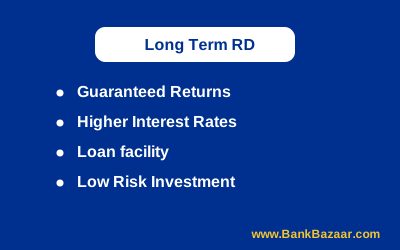
- Loan Facility: Investors can take loans against their deposits, often up to 80%-90% of the deposit amount, although this varies per lender.
RD Article Pages
- Recurring Deposit Vs. Chit Fund
- Miss to Pay the Recurring Deposit Due
- Difference Between Recurring Deposit and SIP
- Open RD Account through HDFC NetBanking
- RD Account in SBI
- Advantages of Recurring Deposit
- Flexi RD
- SBI Flexi RD Schemes
- Indian Bank Recurring Deposit
- Union Bank Recurring Deposit
- UCO Bank Recurring Deposit


FAQs on Long-Term Recurring Deposits
- What is the minimum deposit amount required for such term deposits?
Generally, the minimum investment amount for this type of term deposit is Rs.1,000. However, the specific minimum amount can vary depending on the bank or financial institution.
- Why are long-term recurring deposits considered a popular investment option?
Long-term recurring deposits are popular because they provide guaranteed returns and offer higher interest rates compared to other secure investment options. They are known for their stability and security, making them a preferred choice for many investors.
- How can I open a long-term recurring deposit online?
Traditionally, applying for a long-term recurring deposit involved visiting a bank branch. However, in recent times, the process has shifted to online platforms. To apply for a long-term recurring deposit online, individuals can visit the website of the respective bank or financial institution and follow the instructions provided to open an account and invest in a long-term fixed deposit.
- Is a 20-Year Recurring Deposit Available?
Recurring deposit periods typically range from 7 days to 10 years, and therefore, a 20-year tenure may not be available for fixed deposits.
- Are long-term recurring deposits a recommended investment option?
Investing in long-term recurring deposits offers several advantages, such as the ability to avail a loan against them and more financial benefits.
- Do all banks provide higher interest rates on long-term recurring deposits compared to short- or medium-term deposits?
No, this is not universally true. While some banks may offer higher interest rates for longer-term deposits, it is not a guarantee. Each bank sets its own interest rates, which may or may not be higher for long-term deposits.
- Besides banks, where else can I find options for these types of recurring deposits?
Apart from banks, Non-Banking Financial Companies (NBFCs) and other financial institutions also offer various types of recurring deposits, including long-term deposits.
- Are recurring deposits subject to taxation?
Interest received from recurring deposits is taxable and individuals are required to pay income tax on the interest amount. The tax liability is determined based on the tax slab applicable to the holder of the recurring deposit. Investors with no taxable income can submit Form 15G to avoid Tax Deducted at Source (TDS) on recurring deposits.
- Is it possible to withdraw funds from a recurring deposit account before the maturity date?
No, premature withdrawals from a recurring deposit account are generally not allowed before the maturity date. The funds are locked in for the specified tenure, and early withdrawals may attract penalties or result in the loss of interest earned.

Devarthi Gattuwar is a Finance Content Writer who has experience writing about Credit Cards, Debit Cards, Tax, and other BFSI products. Other than that, she also writes about non-financial utility products like Aadhar Card, Voter ID, Government Certificates, etc. She has a special interest in Social Media Marketing and its nuances. She likes to read and learn new things. She's a mental health advocate and a dog lover. |

Disclaimer
Credit Card:
Credit Score:
Personal Loan:
Home Loan:
Fixed Deposit:


Copyright © 2026 BankBazaar.com.